
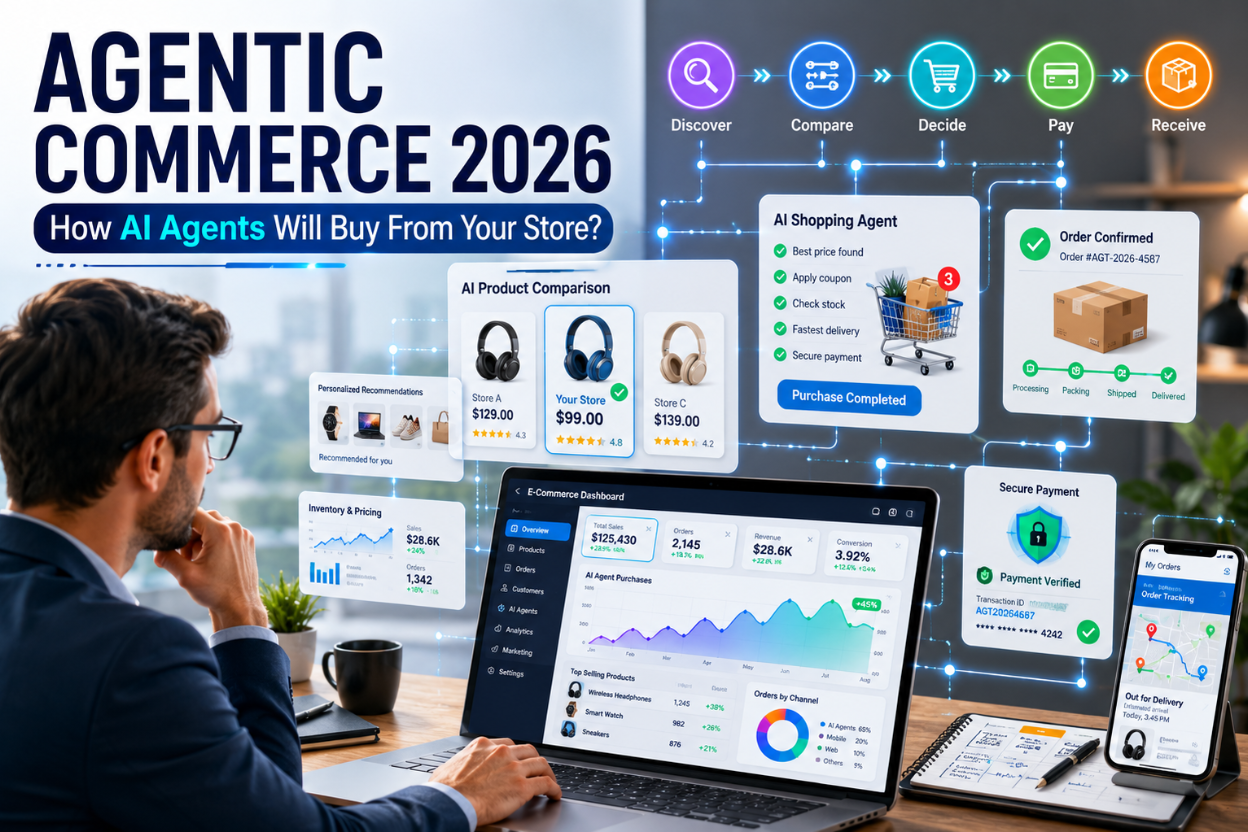
Something changed in how people shop this year, and most store owners haven’t fully clocked it yet. A growing number of buyers aren’t typing a brand name into Google or scrolling through a homepage anymore. They’re telling an AI assistant what they need, and the assistant is doing the rest: comparing prices, picking the right size, checking the delivery date, and completing the purchase.
This is agentic commerce, and it’s no longer a slide on someone’s roadmap. ChatGPT’s Instant Checkout has been live since September 2025, Google rolled out its own commerce protocol in January, and Adobe reports that AI-referred shoppers convert 31% higher than regular search traffic. If you sell anything online, this shift is already brushing against your store, whether you’ve prepared for it or not. It’s also exactly the kind of readiness audit our team at RiseCommerce runs for Magento, Shopify, and Hyvä merchants every week.
What Is Agentic Commerce, Exactly?
Forget the chatbot widget that answers shipping questions in the corner of your screen. AI agents in agentic commerce work differently. A shopper hands the agent a goal, something like “find running shoes under $150, size 10, deliver by Friday”, and the agent goes off and does the legwork itself.
How an AI Agent Actually Completes a Purchase?

- Parses the request into a budget, size, brand preference, and delivery deadline
- Queries product catalogs and pricing feeds across one or more merchants
- Compares offers on price, availability, and delivery certainty
- Builds a cart and checks it against the shopper’s original constraints
- Completes the purchase using payment permission the shopper already granted upfront
The human sets the boundaries; the agent runs the errand. Recent industry research shows close to half of online shoppers already lean on AI for part of their buying journey, mostly for comparing products and reading reviews so far, but checkout is catching up fast.
The New Protocols Letting AI Agents Shop at Your Store
Behind the scenes, a set of new technical standards is doing the heavy lifting so an agent and a store can actually transact with each other.
Universal Commerce Protocol (UCP)
- Built jointly by Google and Shopify
- Lets an AI agent browse a merchant’s catalog, build a cart, and check out
- Designed so merchants don’t need a custom integration for every AI platform
- Already powering early shopping flows inside Google’s AI Mode and the Gemini app
Agentic Commerce Protocol (ACP)
- Built by OpenAI and Stripe, open-source under Apache 2.0
- The system behind ChatGPT’s Instant Checkout
- Already used by Etsy, Instacart, DoorDash, and a growing list of Shopify merchants
Agent Payments Protocol (AP2)
- Originally built by Google, since handed to the FIDO Alliance for shared industry governance
- Doesn’t move money itself; it creates a signed digital record called a Mandate
- Proves a real person authorized an agent to spend a specific amount on a specific item
Visa and Mastercard’s Own Rails
- Visa’s Trusted Agent Protocol and Mastercard’s Agent Pay tackle the same trust problem on their own card networks
- Both are designed to stop a runaway script from quietly draining someone’s card
- Neither has fully converged with AP2 yet, though both networks have committed to interoperability
None of this has fully settled. Think of it as the early years of card networks: several rails competing, slowly converging toward common ground. If you’re not sure which one fits your stack first, our team can help you map it out.
Why 2026 Is the Year This Got Real?
Three Forces Lined Up at Once
- Shoppers got comfortable trusting recommendation engines after years of streaming apps training that habit
- Language models got good enough to understand budgets, sizes, and delivery deadlines from a single sentence
- The major platforms finally built the missing plumbing, the protocols above, so an agent can transact instead of just chatting
The Numbers Behind the Shift
- Adobe recorded a sevenfold jump in AI-driven traffic to retail sites during the last holiday season
- McKinsey expects agentic commerce to redirect $3 to $5 trillion of global retail spend by 2030
- Around 70% of shoppers say they’re at least somewhat comfortable with an agent buying on their behalf, and that number keeps climbing
What This Means If You Run a Magento, Shopify, or Hyvä Store?
This is where it gets practical, and the picture is a little different depending on your platform.
Magento, Adobe Commerce, and Hyvä
- Adobe publicly committed in February to support both UCP and ACP across Adobe Commerce, though there’s no firm release date yet for native support
- Magento Open Source and Hyvä storefronts aren’t shut out in the meantime
- Open-source extensions already exist that add ACP support, letting a store sell inside ChatGPT today
- These rely on Magento’s existing GraphQL API and Stripe for payment, so no enterprise contract is required
Shopify
- Shopify co-built UCP alongside Google, so it has a head start
- Already runs Agentic Storefronts inside ChatGPT, Copilot, and Gemini at once
- Still depends on the merchant’s own product data being complete and accurate
Either way, the platform matters less than whether your product data is actually clean. An agent can’t read a hero banner the way a person can. It reads structured fields: SKU, price, stock status, size, material, return window.
How to Actually Prepare Your Store?
You don’t need to rebuild your stack this quarter. Start with the groundwork that compounds over time.
Fix Your Product Data First
- Add complete Schema.org Product markup to every product page, including price, availability, brand, and GTIN or MPN
- Audit your catalog for missing attributes, vague titles, and zero-result search queries; an agent skips what it can’t parse
- Expose real-time inventory and pricing through an API rather than rendering it only as page text
Pick One Channel and Keep Promises Consistent
- Pilot one protocol first, ChatGPT via ACP or Google’s AI Mode via UCP, instead of chasing all of them simultaneously
- Keep delivery and returns terms consistent across every channel; agents compare merchants on certainty almost as much as price
- Track AI-referred traffic separately in your analytics so you can see what’s actually working
None of this replaces good SEO or solid product photography. It sits alongside both, because a human and an agent are increasingly reading the same page for different reasons.
The Trust Problem Nobody’s Fully Solved Yet
It’s worth being honest about where things actually stand.
What’s Slowing Things Down?
- OpenAI paused parts of its Instant Checkout rollout earlier this year to fix reliability gaps
- The general mood among industry analysts is that enthusiasm is outrunning execution right now
- A recent Optimizely study found that roughly two-thirds of retailers have taken no steps at all to prepare for agentic commerce
That’s either a warning sign or a window of opportunity, depending on which side of it you’re standing on. The merchants moving early aren’t betting on autonomous shopping replacing human browsing overnight. They’re making sure their catalog is legible to a machine now, so that whichever protocol eventually wins, their store isn’t invisible when it does.
Conclusion
Agentic commerce won’t switch on overnight, and it won’t make storefronts irrelevant. What it will do, gradually, is shift part of the buying decision away from a page a human scrolls through and toward a feed a machine reads on their behalf.
- Stores with clean, structured, consistent product data will keep showing up in that feed
- Stores that don’t will start losing sales they never even notice disappear, since there’s no abandoned cart to flag, just an agent that quietly chose a competitor instead
- The fix is unglamorous: better attributes, a working API, honest delivery promises, and one protocol to start with
That groundwork pays off whether agentic commerce takes three years to mature or arrives faster than anyone expects. If you run a Magento, Shopify, or Hyvä store and want a clear-eyed look at how ready your catalog actually is, that’s a conversation worth having before your competitors have it first.
FAQs
1. What is agentic commerce in simple terms?
It’s when an AI agent, rather than a human clicking through pages, handles the shopping process end to end: comparing products, building a cart, and completing checkout based on goals a person sets in advance.
2. Is agentic commerce actually live, or still just a concept?
It’s live in pieces, ChatGPT’s Instant Checkout has been running since September 2025 for select US merchants, and Google’s Universal Commerce Protocol launched in January 2026, but fully autonomous checkout at scale is still being built out.
3. Do I need Adobe Commerce to make my Magento store AI-agent ready?
No. Magento Open Source and Hyvä storefronts can add agent support today through open-source extensions that use the existing GraphQL API and Stripe, without waiting for Adobe’s native rollout.
4. What’s the difference between UCP and ACP?
UCP, built by Google and Shopify, covers the full journey from discovery through checkout across multiple AI surfaces. ACP, built by OpenAI and Stripe, powers ChatGPT’s checkout specifically. Many merchants will end up supporting both.
5. What is AP2, and do I need to integrate it myself?
AP2 is the verification layer that proves a real customer authorized an agent’s purchase. Most merchants won’t integrate it directly; their payment processor handles AP2 compliance behind the scenes.
6. Will AI shopping agents replace SEO?
Not replace it, but reshape it. Ranking on a search results page still matters, but being selected inside an AI agent’s answer increasingly depends on structured product data rather than keyword-rich content alone.
7. Is my Shopify store already set up for this?
Partially. Shopify co-built UCP and offers Agentic Storefronts that plug into ChatGPT, Copilot, and Gemini, but you still need clean product data and accurate delivery information for an agent to select your products with confidence.
8. What’s the single most important first step for a store owner?
Audit your product pages for complete structured data: price, availability, brand, and GTIN, then fix zero-result search queries. AI agents skip incomplete listings the same way a careful shopper would.
9. Will AI agents only matter for big retailers like Amazon and Walmart?
No. Independent merchants on Magento, Shopify, and other platforms can plug into the same protocols, sometimes bypassing marketplaces entirely by routing AI-driven traffic straight to their own checkout.
10. How long do I have before this becomes urgent?
Longer than the headlines suggest, but shorter than comfort allows. Analysts expect agentic commerce to influence a meaningful share of online sales by 2028 to 2030, and the groundwork, clean data and a working API, takes months to put in place, not days. Prefer to talk it through directly? Call RiseCommerce at +919839374777.