
Which Is Truly Cost-Effective at Scale?
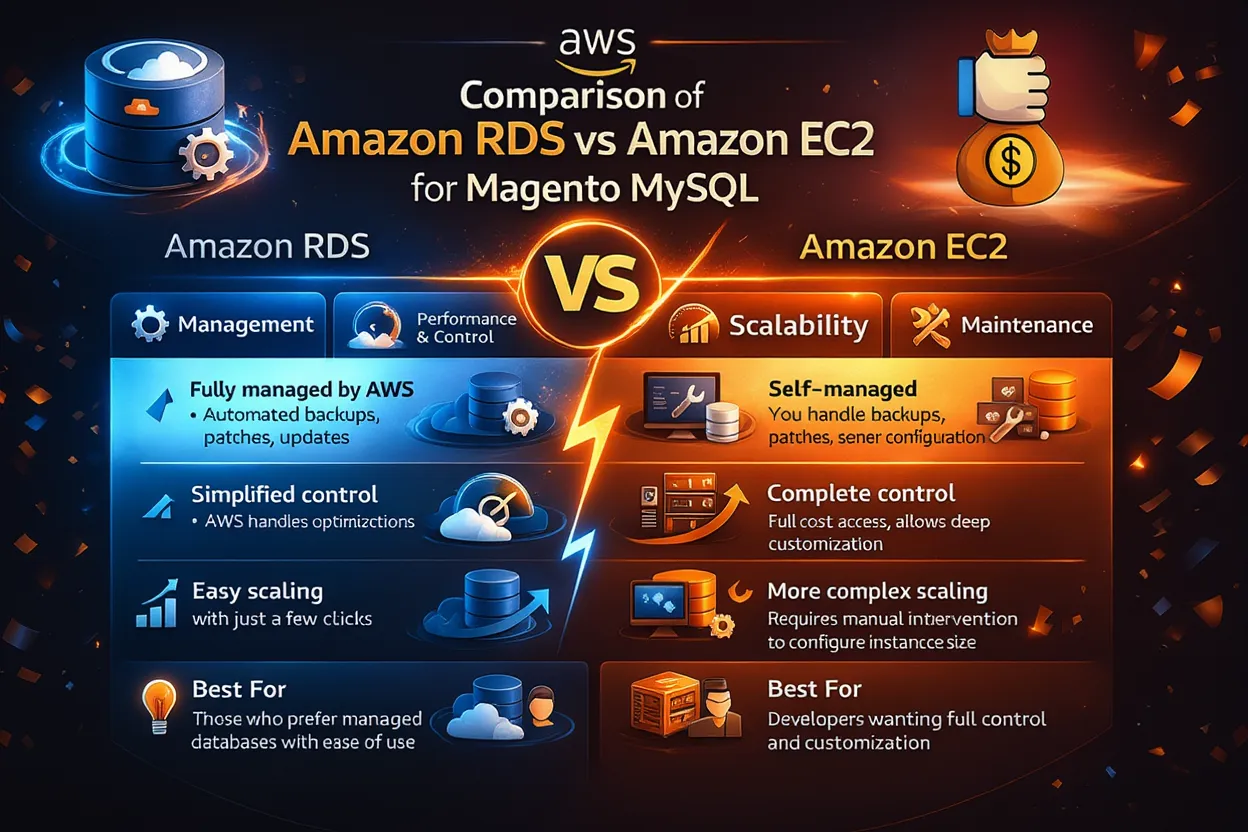
When running a Magento or Adobe Commerce store, database architecture decisions directly affect performance, uptime, and AWS spend. One of the most common questions CTOs and product owners ask is whether Magento should run on Amazon RDS or on Amazon EC2 with a self-managed MySQL/MariaDB database.
AWS documentation frames this as a simple choice between a managed service and infrastructure control. In real Magento production environments, that framing is incomplete.
Based on enterprise-scale Magento experience—including 50,000+ SKU catalogs, millions of daily visitors, and flash-sale-level traffic spikes—the real answer depends on three things: application efficiency, operational maturity, and cost behavior under load.
Before comparing RDS and EC2 directly, it is critical to understand a truth many teams discover too late.
Application Optimization Changes the RDS vs EC2 Equation
Infrastructure alone does not determine Magento database cost or stability. In real production environments, a large portion of MySQL load is not caused by traffic volume, but by inefficient application behavior.
At RiseCommerce, database cost optimization rarely starts with resizing instances or switching platforms. It starts by reducing unnecessary database queries before they ever reach MySQL.
Magento is extremely sensitive to inefficient API usage, synchronous processing, and frontend over-fetching. Addressing these issues often produces greater cost savings than changing the database platform itself.
API Optimization and Queue-Based Processing in Adobe Commerce
Magento and Adobe Commerce rely heavily on API-driven workflows, particularly in enterprise setups with ERPs, PIMs, and bulk catalog operations.
By optimising API usage through batch processing, RiseCommerce has consistently reduced MySQL query load by 30–50% in production. This includes batching bulk product imports using Adobe Commerce REST API batching instead of triggering thousands of individual write operations.
Order processing and post-checkout workflows are also moved into asynchronous queues. Instead of MySQL absorbing massive write spikes during flash sales, requests are processed in controlled batches. This dramatically improves database stability during promotions, reindex operations, and high-concurrency events.
These changes alone often stabilise RDS environments that previously appeared to be “under-provisioned.”
Frontend Optimisation Directly Reduces Database Pressure
Database optimization does not stop at the backend.
Magento frontends frequently generate excessive database reads due to eager loading of catalog data and unnecessary API calls. Through frontend optimization techniques such as lazy loading, deferring non-critical requests, and minimizing redundant catalog queries, read pressure on MySQL drops significantly.
In practice, this results in fewer open MySQL connections, lower query contention, and far better predictability during traffic spikes. Page performance improves while database concurrency decreases—a rare win-win scenario.
Redis (Amazon ElastiCache) as a Cost-Control Lever
For medium to large Magento infrastructures, Amazon ElastiCache (Redis) is one of the most effective cost-control tools available, regardless of whether MySQL runs on RDS or EC2.
By aggressively using Redis for session storage and catalog caching, RiseCommerce has helped Magento clients achieve up to 40% infrastructure savings on larger deployments. Offloading read traffic from MySQL prevents connection pool exhaustion, which is one of the most common failure modes during flash sales and concurrent reindex operations.
In many cases, investing in Redis delivers a better return than upgrading database instance sizes. It stabilizes Magento under load and delays—or eliminates—the need for expensive database scaling.
How Magento Databases Behave Under Real Traffic
Magento databases behave very differently from typical MySQL workloads. They involve heavy joins, fast-growing InnoDB indexes, concurrent reads and writes, and sudden traffic surges driven by campaigns and promotions.
A database setup that looks stable in staging can become a bottleneck within minutes of a major sale. This is why RDS versus EC2 decisions should be evaluated through the lens of traffic volatility and growth patterns, not theoretical benchmarks.
Amazon RDS for Magento: Strengths and Hidden Costs
Amazon RDS is often the right starting point for Magento stores. It simplifies patching, backups, and replication, allowing teams to move faster with less operational risk.
However, as Magento traffic increases, RDS reveals cost behaviors that are not obvious upfront.
IOPS Cost Spikes in Magento Workloads
Magento generates short but intense query bursts during checkout flows, layered navigation, and indexing. In production, these bursts caused provisioned IOPS usage to spike, billed at roughly $0.125 per provisioned IOPS-month.
This resulted in 25–40% higher RDS bills during peak months, without any change in instance size. The cost increase came purely from IOPS usage, making spend difficult to predict.
Multi-AZ Reality During Magento Peaks
Multi-AZ is often assumed to provide near-instant failover. In real Magento traffic scenarios, this assumption can fail.
During a high-traffic Magento event, a Multi-AZ failover resulted in 5–8 minutes of downtime, largely due to DNS caching at the application and client levels. For revenue-critical events, this downtime is costly.
Multi-AZ improves durability, but it does not eliminate outage risk.
Storage and Backup Growth Over Time
Magento index tables grow aggressively. On RDS, gp3 storage autoscaling caused volumes to grow nearly twice as fast as forecast, adding recurring costs at approximately $0.08 per GB per month.
Long-running Magento databases also frequently exceed the free backup threshold due to retained binary logs. Once exceeded, backup storage costs increase steadily, often without immediate visibility.
Amazon EC2 for Magento MySQL: Control and Performance
Running MySQL or MariaDB on EC2 shifts responsibility to your team, but it unlocks performance and cost advantages that RDS cannot offer.
With EC2, teams can apply deep database and OS-level tuning. Custom InnoDB buffer pool sizing, optimized log file configuration, and NVMe-backed RAID-10 setups delivered 40–60% lower query latency and nearly three times higher write throughput compared to RDS gp3-constrained instances.
Magento timeout issues observed on RDS disappeared entirely under EC2-based setups.
The Real Cost of EC2 (And Why Discipline Matters)
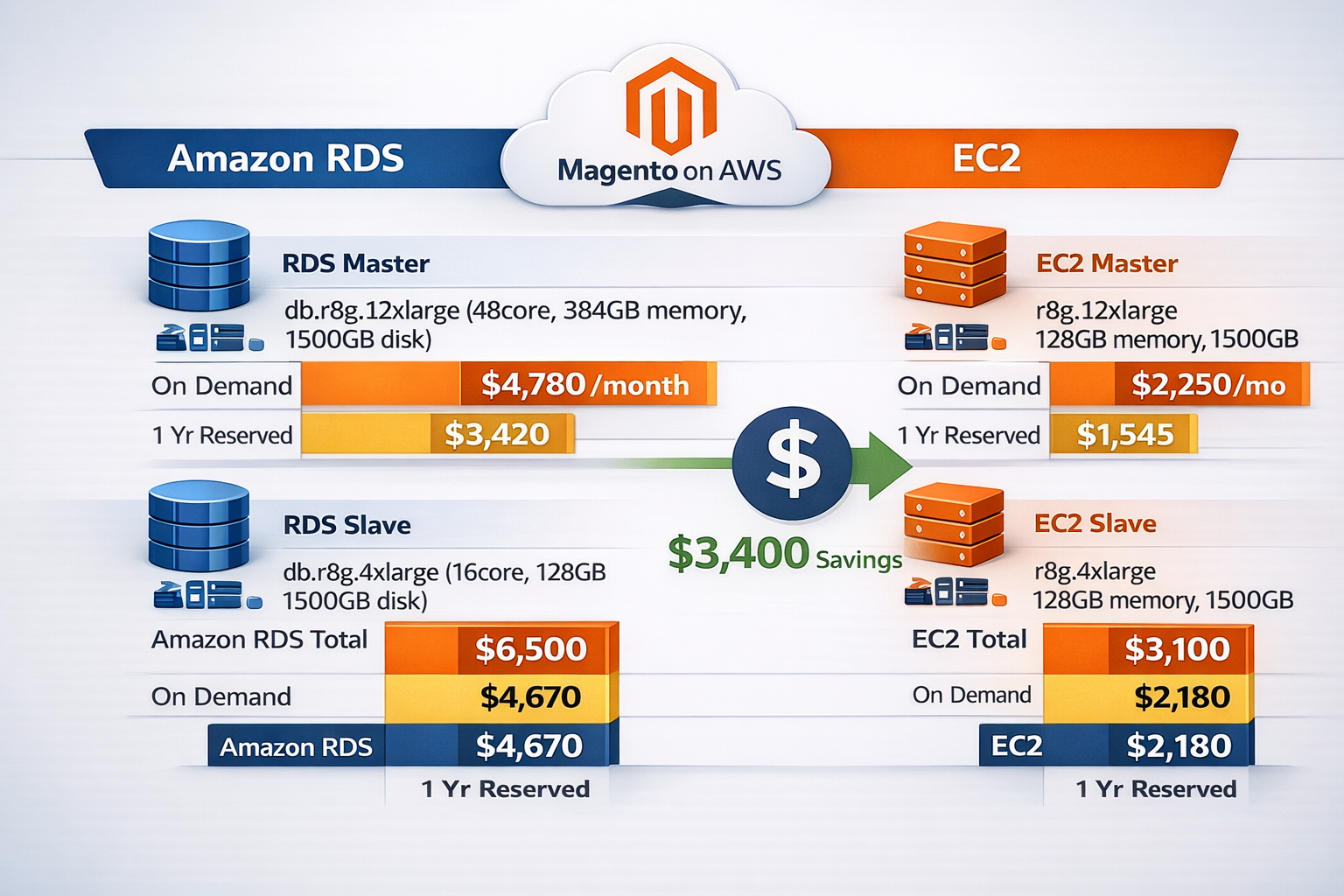
EC2 is not cheaper by default. Idle Auto Scaling instances, cross-AZ data transfer, and forgotten snapshots can inflate costs by 10–20%.
Once these issues were addressed through automation and monitoring, EC2-based Magento databases became up to 40% cheaper than RDS, while supporting significantly higher traffic.
EC2 rewards operational discipline. Without it, any cost advantage disappears.
Why Optimization Must Come Before Platform Choice
These application-level optimizations fundamentally change the RDS versus EC2 decision.
A poorly optimized Magento application will overwhelm any database platform. An optimized application can extend the lifespan of RDS significantly or reduce the operational burden of EC2.
In multiple production cases, implementing API batching, queue processing, frontend optimization, and Redis caching delayed costly database migrations by months—or eliminated them entirely.
Database infrastructure decisions should follow application optimization, not precede it.
Final Verdict for CTOs and Product Owners
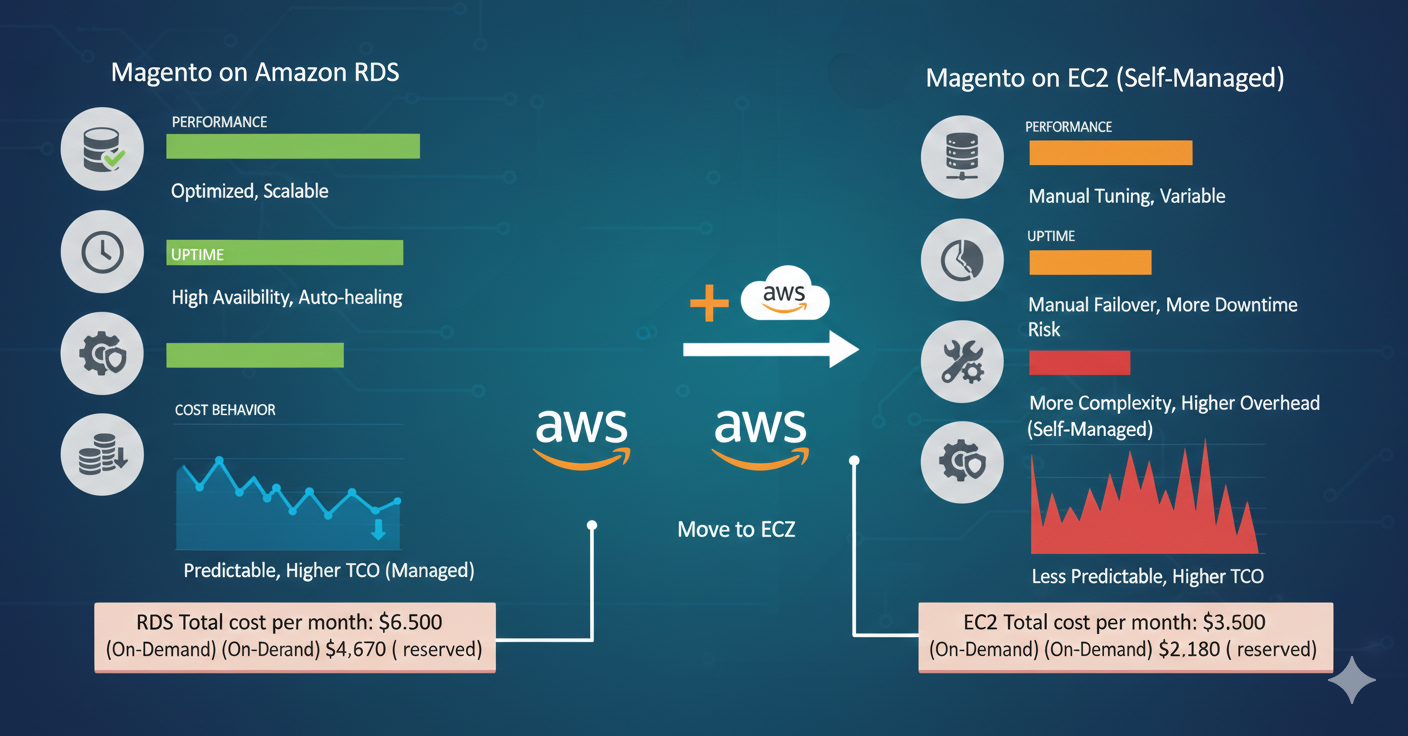
Amazon RDS is a risk-reduction tool.
Amazon EC2 is a performance and cost-optimization tool.
Magento stores run into trouble when teams choose convenience without understanding long-term cost behavior, or choose flexibility without operational readiness.
The most expensive architecture is not RDS or EC2.
It is scaling the wrong thing first.
Call to Action: Optimize Before You Scale
If your Magento AWS bills are rising faster than traffic, or your store struggles during peak events, RiseCommerce can help.
We specialize in:
- AWS cost optimization for Magento and Adobe Commerce
- RDS and EC2 MySQL performance tuning
- API batching, queue-based processing, and frontend optimization
- Redis (Amazon ElastiCache) architecture for high-traffic stores
- Real-world, production-tested scalability strategies
Contact RiseCommerce to audit and optimize your AWS Magento infrastructure:
👉 https://risecommerce.com/contact
Optimizing correctly often saves more than migrating platforms.