Your Magento storefront is no longer just a design choice — in 2026, it directly determines your Google rankings, your conversion rate, and how much your team spends on every future update.
- Core Web Vitals
- LCP benchmarks
- PageSpeed scores
- Extension compatibility
- Total cost of ownership
- Magento 2 themes

Luma has been Magento’s default theme since version 2.0 — stable, free, and compatible with nearly every third-party extension. For many store owners, it’s been the obvious starting point. But Luma was built on a frontend stack that’s now showing its age: KnockoutJS, RequireJS, LESS, and hundreds of JavaScript dependencies that weigh down every page load.
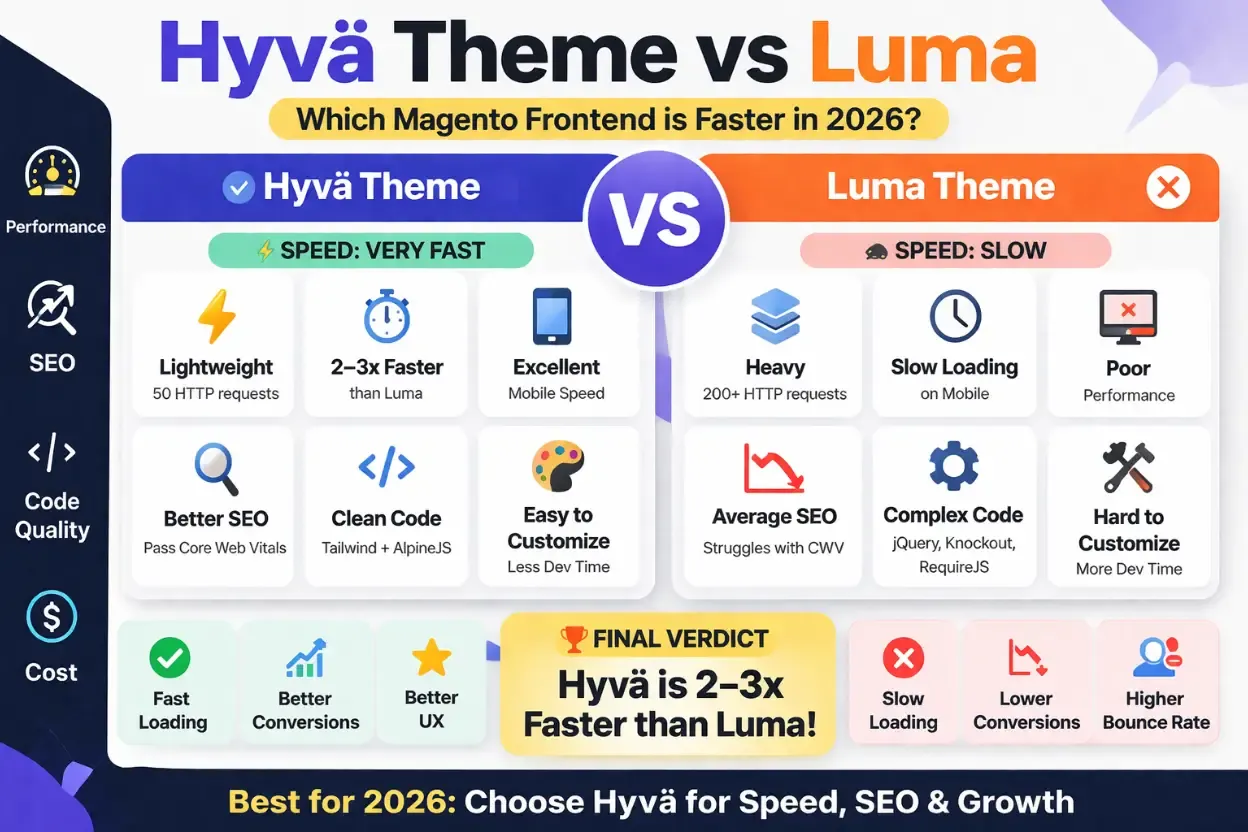
Hyvä, built by HYVA.io on Tailwind CSS and Alpine.js, was designed as a direct answer to Luma’s performance ceiling. It strips the frontend down to just two JS/CSS resources, delivers Largest Contentful Paint scores between 1.2 and 1.8 seconds on mobile, and loads 2–3× faster overall. With Google’s Core Web Vitals now a confirmed ranking signal, that gap translates directly into search visibility, bounce rates, and revenue.
Understanding Magento Frontends: Luma vs Hyvä
First, let’s start with defining what Luma and Hyvä themes are.
Luma Theme (Default Magento Frontend)
Luma is a default Magento theme that uses KnockoutJS, RequireJS, and LESS for creating pages. It has everything you could ask for in a frontend theme, but some developers dislike it for being complicated and resource-intensive.
But developers still use the Luma frontend for one reason—Magento includes it by default and supports all the default Magento functions.
Hyvä Theme (Modern Lightweight Frontend)
Hyvä is the latest Magento frontend framework that was created specifically to eliminate the disadvantages of Luma. Unlike Luma, Hyvä discards many JavaScript frameworks and uses Alpine.js and Tailwind CSS instead. This makes Hyvä incredibly fast.
That is precisely why the debate about Hyvä theme vs Luma 2026 is so heated.
Hyvä vs Luma Performance: The Real Difference
The difference between Hyvä and Luma when it comes to frontend performance can be enormous.
1. Page Load Speed
One of the most obvious benefits of using Hyvä is its impressive loading speed.
- Luma tends to load several JavaScript files (usually over 2 MB)
- Hyvä manages to minimize the number of scripts (sometimes under 200 KB)
This allows pages to be rendered much quicker.
Here we see the difference between Hyvä vs Luma, where Hyvä wins thanks to its lightweight design.
2. Core Web Vitals
In 2026, Google Core Web Vitals became one of the most important ranking factors.
- Luma usually performs poorly in terms of Largest Contentful Paint and Time to Interactive.
- By reducing render-blocking scripts, Hyvä improves these parameters drastically.
As a consequence, websites powered by Hyvä have better PageSpeed scores.
This is why many companies strive to increase their Magento Hyvä theme speed today.
3. JavaScript Complexity
Luma depends on:
- KnockoutJS
- RequireJS
- jQuery
Such dependencies complicate the rendering process, slowing it down.
Hyvä makes the development easy, thanks to:
- Alpine.js (lightweight reactive framework)
- Minimal JavaScript logic
It is an important distinction for any Luma vs Hyvä frontend comparison.
Luma Theme Performance Issues
Despite being perfectly functional, Luma suffers from multiple cons:
1. Heavy Frontend Architecture
The layered architecture of Luma requires:
- Several JS dependencies
- Complicated rendering processes
- Additional load on the server
They are typical Luma theme performance issues faced by web developers.
2. Slow Page Rendering
Due to the inclusion of many scripts and CSS codes, Luma can lead to:
- Delayed interactivity
- Long page load time
- Ineffective mobile operation
3. Difficult Debugging
It is difficult to debug the Luma-powered website because of:
- Complex JS design
- Element coupling
4. High Development Cost
In view of its complexity, developing Luma stores takes more time.
Such cons should be considered carefully when deciding to use the Luma theme Magento.
Benefits of Hyvä Theme Magento
Since Hyvä fixes all problems inherent to Luma, it became extremely popular among Magento developers.
Here are Hyvä’s pros:
1. Lightning-Fast Performance
Hyvä eliminates:
- JavaScript size
- CSS overhead
- HTTP requests
The result is excellent performance for Hyvä theme Magento.
2. Simpler Development
Hyvä works with:
- Tailwind CSS for styles
- Alpine.js for interactivity
The process becomes easier and less time-consuming.
3. Better User Experience
Thanks to fast load speed, there is:
- Lower bounce rates
- Higher engagement
- Improved conversions
4. SEO Advantages
Due to better Core Web Vitals, you can enjoy:
- Higher search engine rankings
- Increased organic traffic
5. Reduced Maintenance
Because of fewer dependencies, you’ll experience less:
- Less debugging
- Easier updates
- Lower long-term costs
Luma vs Hyvä Frontend Comparison (Quick Overview)
| Feature | Luma Theme | Hyvä Theme |
| Performance | Moderate to Slow | Extremely Fast |
| JavaScript | Heavy (Knockout, RequireJS) | Lightweight (Alpine.js) |
| CSS | LESS | Tailwind CSS |
| Developer Experience | Complex | Simple |
| Core Web Vitals | Weak | Strong |
| Customization | Time-consuming | Flexible |
| Maintenance | High | Low |
This table summarizes the essential Luma vs Hyvä frontend comparison.
Should I Switch from Luma to Hyvä?
This question comes up most often when Magento store owners consider whether they should go from Luma to Hyvä.
Consider Switching If:
- Your website performs poorly
- You need help with Core Web Vitals
- The development process is expensive
- You want a modern frontend stack
You Might Stay on Luma If:
- Your store works extensively with third-party modules that don’t work with Hyvä
- There isn’t enough money for redevelopment
- Your website performance is fine
Migration Considerations
A switch from Luma to Hyvä goes beyond a simple theme switch and entails rebuilding the whole frontend.
What to Look At While Making a Change:
- Compatibility of extensions
- Costs of development
- Customizing design
Hyvä Theme vs Luma 2026: What’s the Future?
In terms of the future, the Hyvä theme vs Luma 2026 discussion becomes obvious.
Industry Trends
- Speed and better UX are among the top priorities
- Bulky architecture is replaced by lightweight frameworks
- Simplification of tech stacks
Magento Ecosystem Shift
Hyvä theme adoption will continue:
- Hyvä-compatibility of more extensions
- Growing developer community
- Agency advice on using Hyvä for new projects
Luma’s Role
It’s unlikely that Luma will vanish, yet:
- It will become less important
- Stores with higher performance needs will abandon Luma
Real-World Impact of Switching to Hyvä
Some Magento store owners noticed:
- 30-50% faster website performance
- Higher conversion rate
- Less development time
And these changes explain the reason why Hyvä vs Luma performance matters so much.
Final Verdict: Which One is Faster?
As speed is important, there is no doubt – Hyvä wins.
- Fast loading speeds
- Better scores for Core Web Vitals
- Simplified development
- Improved UX
As it’s evident, Luma cannot stand against Hyvä performance.
Conclusion
The decision to go with either Hyvä or Luma in 2026 revolves around a single important
key factor: performance.
Even though Luma has been used by Magento shops for many years, its shortcomings have become more and more obvious due to the always changing digital landscape. In contrast, Hyvä presents itself as a superior and high-performing option that meets today’s web standards.
Whichever way you decide to develop your online store, knowing about Hyvä vs Luma performance is necessary. If speed, efficiency, and user experience are important for your company, switching to Hyvä could be an effective solution.
Uncertain about whether I should migrate from Luma to Hyvä? This is a personal decision that will depend on your objectives, but it’s clear what needs to be done if you value performance.
Ready to improve your store speed and conversions?
Contact us today at https://risecommerce.com or call +919839374777.
FAQs
1. What is the main difference between Hyvä and Luma?
The main difference lies in performance and architecture. Hyvä is lightweight and fast, while Luma is heavier and more complex.
2. Is Hyvä faster than Luma?
Yes, Magento Hyvä theme speed is significantly better due to reduced JavaScript and optimized design.
3. Why does Luma perform poorly?
Luma theme performance issues stem from heavy JS usage, outdated frameworks, and complex architecture.
4. Is Hyvä good for SEO?
Yes, Hyvä improves Core Web Vitals, which directly impacts search engine rankings.
5. Should I switch from Luma to Hyvä?
If performance and user experience matter to your business, then should I switch from Luma to Hyvä – the answer is likely yes.
6. Is Hyvä compatible with all Magento extensions?
Not all extensions are compatible out of the box, but many can be adapted.
7. What are the benefits of the Hyvä theme Magento?
The benefits of Hyvä theme Magento include faster speed, better UX, improved SEO, and easier development.
8. What are the disadvantages of Luma theme Magento?
The disadvantages of Luma theme Magento include slow performance, high complexity, and poor Core Web Vitals.
9. Is Hyvä worth the investment in 2026?
Yes, especially for businesses focused on growth, performance, and scalability.
10. How long does it take to migrate from Luma to Hyvä?
It depends on store complexity, but typically ranges from a few weeks to a couple of months.