Every online shopper has been there – browsing a store at midnight, stuck with a question about sizing, shipping, or return policy, and no one available to help. That moment of hesitation often leads to an abandoned cart and a lost sale.
This is exactly why a conversational chatbot for eCommerce has become a must-have rather than a nice-to-have. Stores of every size, from single-product Shopify brands to large Magento marketplaces, are plugging chatbots into their storefronts. And the results speak for themselves: faster responses, higher conversions, and customers who actually come back.
Let me walk you through how these chatbots work under the hood, why they matter now more than ever, and what you should know before adding one to your store.
What Is a Conversational Chatbot for eCommerce?
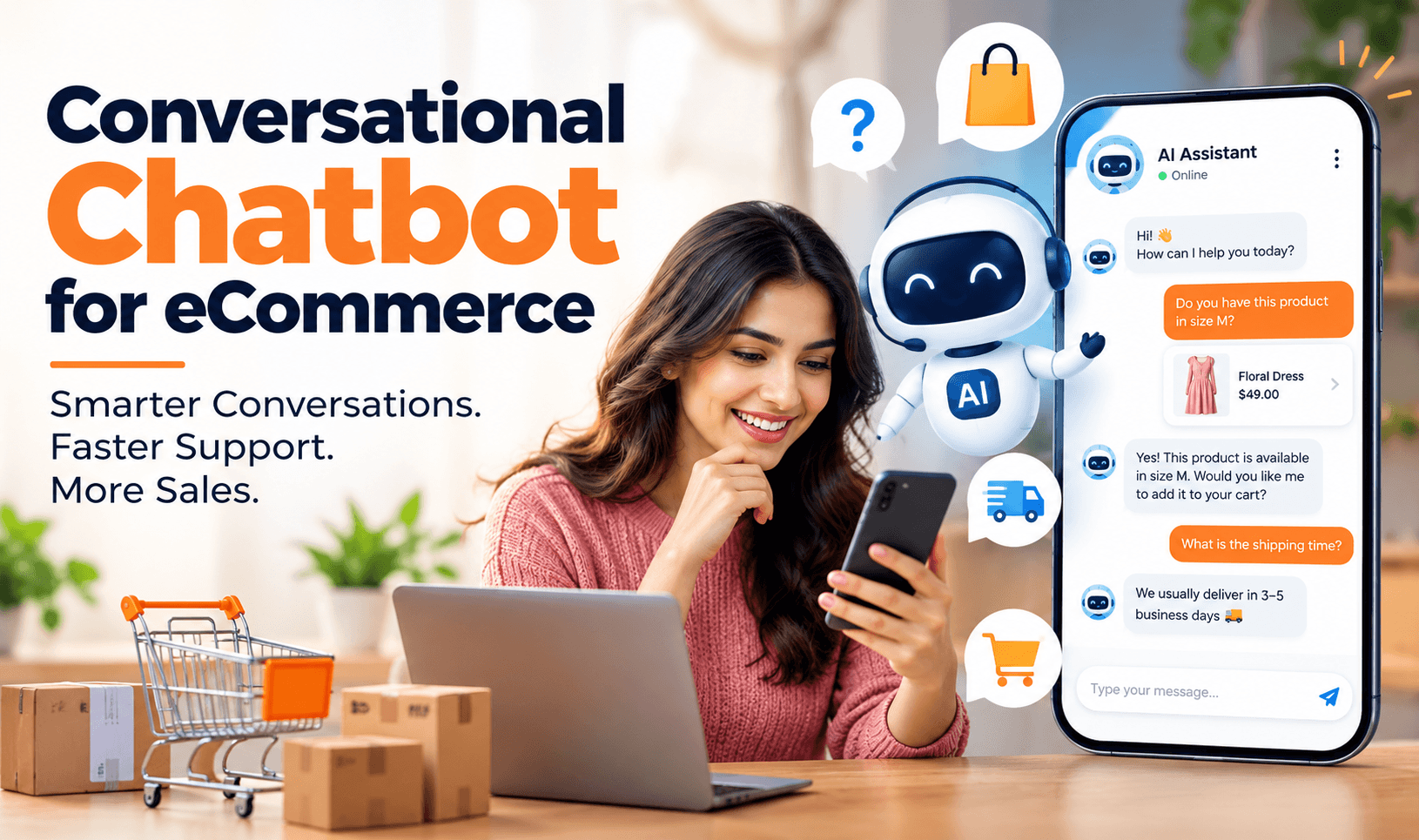
A conversational chatbot is a software tool that talks to your website visitors in real time. Unlike the clunky, scripted bots from a few years ago that only answered preset questions, modern eCommerce chatbots understand natural language. A customer can type “Do you deliver to Jaipur?” or “Show me something similar to this jacket” and the bot handles it smoothly.
These bots sit on your product pages, cart page, or homepage. Some work through WhatsApp, Instagram DMs, or Facebook Messenger too. The goal is simple – keep the conversation going so the shopper does not leave without buying.
If your store runs on a platform like Magento or Shopify, integrating an AI-powered chatbot is now far easier than it was even two years ago.
How Does an eCommerce Chatbot Actually Work?
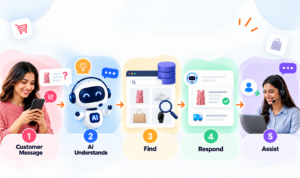
Here is a simplified breakdown of what happens behind the scenes:
- Customer sends a message – The shopper types a question or clicks a quick-reply button on the chat widget.
- Natural Language Processing (NLP) kicks in – The bot reads the message, identifies the intent (is the person asking about a product, a refund, or delivery?), and pulls out key details like product names, order numbers, or locations.
- The bot checks your store data – It connects to your product catalog, inventory system, order database, or CRM to fetch the right answer. This is where proper eCommerce marketplace development matters because clean data makes chatbots smarter.
- It responds instantly – Within seconds, the customer gets a relevant answer, a product recommendation, or a link to track their order.
- Escalation when needed – If the question is too complex, the bot hands the conversation to a human agent with full context, so the customer never has to repeat themselves.
The whole loop takes seconds. No hold music, no “we will get back to you in 24 hours.”
Why Are eCommerce Stores Adding Chatbots Right Now?

Several real-world reasons are pushing store owners toward chatbot integration:
Round-the-clock support without hiring more staff – Your store is open 24/7, but your team is not. A chatbot fills that gap during nights, weekends, and holidays. For businesses managing multiple stores or complex catalogs, this saves thousands in support costs every month.
Higher conversion rates – A shopper who gets an instant answer is more likely to complete the purchase. Chatbots reduce friction at the exact moment when hesitation sets in. Pairing a chatbot with a well-designed store experience creates a buying journey that feels effortless.
Personalized product recommendations – Modern chatbots learn from browsing behavior and past orders. They suggest products the shopper is likely to buy, similar to how a helpful store assistant would guide someone in person.
Cart recovery – When someone abandons their cart, the chatbot can follow up with a gentle nudge or even offer a discount code. This is one of the simplest ways to recover revenue you are already losing.
Reduced load on support teams – Common questions like “Where is my order?” or “What is your return policy?” eat up hours of agent time. A chatbot handles these instantly, freeing your team to focus on complex issues.
Types of Chatbots Used in eCommerce
Not every chatbot is built the same. Here are the main types you will come across:
Rule-based chatbots – These follow a fixed decision tree. They work well for FAQs and basic queries but struggle with anything unexpected.
AI-driven chatbots – These use machine learning and NLP to understand and respond to open-ended questions. They improve over time as they handle more conversations.
Hybrid chatbots – A combination of scripted flows and AI capabilities. This is the most popular approach for mid-size and large eCommerce stores because it balances cost and performance.
Choosing the right type depends on your store size, traffic, and budget. If you need guidance, a strong custom CRM and integration strategy ensures your chatbot connects seamlessly with your existing tools.
What Makes a Good eCommerce Chatbot?
Not every chatbot delivers results. The ones that actually move the needle share a few things in common:
- They load fast and do not slow down your site. Speed matters, especially when your UI/UX design is already optimized for quick interactions.
- They are connected to live inventory and order data – no outdated answers.
- They support multiple languages if you sell internationally.
- They hand off to humans gracefully when they reach their limit.
- They work on mobile just as well as on desktop. If you are building or upgrading your mobile app, the chatbot should be part of that plan.
How to Get Started with a Chatbot on Your Store?
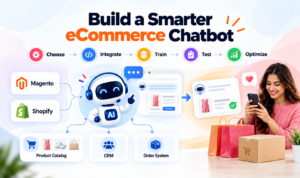
Adding a chatbot is not a weekend project if you want it done right. Here is the practical path:
Step 1 – Map out the top 20-30 questions your customers ask repeatedly. Your support inbox is the best source for this.
Step 2 – Pick a chatbot platform that integrates with your eCommerce stack. Magento stores, Shopify stores, and WooCommerce stores each have different integration requirements.
Step 3 – Connect the bot to your product catalog and order management system so it pulls real-time data.
Step 4 – Train and test the bot with real customer queries before going live.
Step 5 – Monitor performance weekly. Good digital marketing and SEO practices include tracking chatbot metrics like resolution rate, drop-off points, and customer satisfaction.
If you are running a Magento store and need technical help with chatbot integration or any custom module work, our team offers dedicated eCommerce support packages built for exactly this kind of work.
Conclusion
A conversational chatbot for eCommerce is no longer a futuristic add-on. It is a practical tool that pays for itself by converting more visitors, supporting customers around the clock, and reducing the load on your team. Whether you run a Shopify brand or a complex Magento marketplace, the right chatbot makes your store feel responsive, helpful, and always available.
The stores that are growing fastest right now are not just spending more on ads. They are investing in smarter website development that includes tools like chatbots, personalized experiences, and seamless integrations. If you have not added one yet, now is the time to start.
Have questions about adding a chatbot to your eCommerce store? Get in touch with us – we would love to help.
FAQs
1. What is a conversational chatbot for eCommerce?
A conversational chatbot is a software tool embedded on an online store that interacts with visitors in real time, answering product questions, helping with orders, and guiding shoppers through their buying journey.
2. How does a chatbot increase eCommerce sales?
It removes friction at decision-making moments by providing instant answers about products, pricing, availability, and shipping, which reduces cart abandonment and improves conversion rates.
3. Can a chatbot work with Magento and Shopify stores?
Yes. Modern chatbot platforms offer integrations for Magento, Shopify, WooCommerce, BigCommerce, and other popular eCommerce platforms.
4. Is a chatbot better than live chat for online stores?
A chatbot handles routine questions instantly and is available 24/7. Live chat requires human agents. The best approach is a hybrid setup where the bot handles common queries and escalates complex ones to a human.
5. How much does it cost to add a chatbot to an eCommerce website?
The cost depends on the type of chatbot, the level of customization, your store platform, and the volume of conversations it handles. Rule-based bots are generally affordable, while AI-driven chatbots with deep integrations require a higher investment. It is best to evaluate your store needs and compare providers before committing.
6. Can an eCommerce chatbot handle product recommendations?
Yes. AI chatbots analyze browsing history, purchase patterns, and customer preferences to suggest relevant products during the conversation.
7. What kind of questions can an eCommerce chatbot answer?
Common ones include order tracking, return and refund policies, product availability, sizing guides, shipping timelines, discount codes, and store location details.
8. Will a chatbot slow down my website?
A well-built chatbot loads asynchronously and should not affect page speed. Poor implementations can add weight, so choosing the right provider and proper technical setup matters.
9. Can a chatbot reduce customer support costs?
Absolutely. Chatbots handle 60-80% of repetitive queries without human involvement, significantly cutting down on support staff workload and costs.
10. How do I choose the right chatbot for my online store?
Look for platform compatibility, NLP capabilities, multi-channel support, easy integration with your product catalog and CRM, and the ability to escalate to live agents when needed.