Managing a business today involves working with an increasing amount of customer data coming in from a variety of sources, long sales cycles, and high customer expectations. Using old-school tools like spreadsheets for managing all these contacts manually is simply inefficient.
Enter the modern era of custom CRM development service, enhanced even further by artificial intelligence. Regardless of your business stage – whether you are an entrepreneur starting a venture from scratch, have a small growing business, or an enterprise-scale company wanting to upscale – understanding what CRM software is and the role of AI within it may open new horizons in the field of customer relationship management.
Table of Contents
ToggleWhat is CRM software?
The term customer relationship management software refers to a type of platform used for managing contacts and leads. It includes all types of interactions and communications between the customers and the company and stores them on one platform.
More than just another way of saving contact information, CRM represents a set of tools used by companies to get to know where each of their clients is at a certain point of their journey to becoming a customer.
Modern CRM software covers:
- Management of contacts and leads
- Pipeline analysis in sales
- Automation of tasks and reminders
- Dashboards for reports and performance
- Interactivity through email, phone, and marketing applications
When AI is implemented into such a system, it enhances all of its capabilities and increases its efficiency, speed, and predictability.
Why Businesses are Moving toward AI-Based CRM?
The biggest complaint about older CRM tools is that they require too much manual input. Sales reps spend hours logging calls, updating records, and sorting leads, time that should go toward actual selling.
An AI-based CRM system for customer retention solves this by automating routine tasks and surfacing insights that a human would likely miss.
Here is what shifts when AI enters the picture:
- Predictive lead scoring ranks your prospects by how likely they are to convert, based on behavioural patterns, past interactions, and real-time signals. Your team stops guessing and starts focusing on the leads that actually matter.
- Automated follow-ups trigger at the right moment, whether that is after a product page visit, a cart abandonment, or a support ticket resolution. The message goes out without anyone needing to manually schedule it.
- Sentiment analysis reads customer emails and chat messages to flag frustration, interest, or urgency. Your team can respond to at-risk customers before they decide to leave.
- Sales forecasting uses historical data and current pipeline activity to predict revenue with far more accuracy than gut instinct allows.
These are not future possibilities. Businesses using AI powered CRM today are already seeing measurable lifts in close rates, customer satisfaction scores, and team productivity.
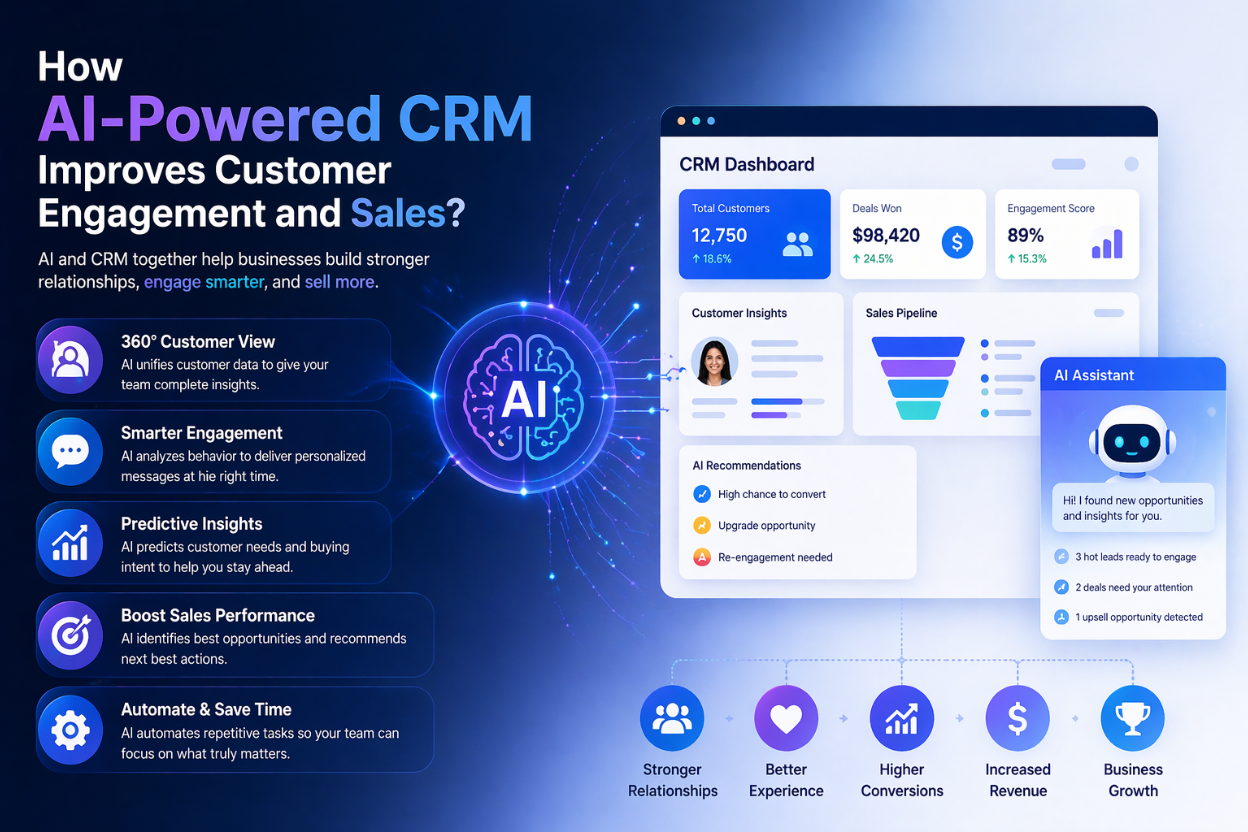
How AI-Powered CRM Improves Customer Engagement?
Customer engagement does not only require mailing more emails. It requires sending the appropriate message to the correct customer at the optimal time.
By studying behavior patterns, engagement metrics, preferred times for opening an email, and issues they have raised in the past, AI powered CRM platforms create more precise customer profiles which allow for highly personalized communication.
For instance, instead of sending the same promotion to everyone in your mailing list, you could use an AI driven best marketing CRM software to segment audiences according to purchase history, level of engagement, and likely intent. A new visitor sees one type of content, while someone who bought a month ago gets a different one.
Such an approach to customer communication makes them feel understood rather than advertised to, leading to much higher levels of engagement.
Apart from emails, AI can help you with:
- Personalized live chat, where the platform will display the customer’s profile before the agent starts typing
- Product suggestions based on their behavior
- Proactive contact in case of detecting potential churn
- Onboarding flows that adjust to the user’s behavior with your product
The outcome is a personalized customer experience, even when it is automated.
How AI-Powered CRM Drives Sales Growth?
Customer engagement that does not lead to conversions is just a distraction. The true value of any best CRM software is determined by its revenue-generating capabilities.
AI affects the sales process in every step of the funnel.
- At the top of the funnel, there is assistance with inbound leads qualification at the upper end of the sales funnel. In essence, you no longer waste time evaluating all incoming leads since your focus will be on the accounts scored highly by your system.
- In the middle of the funnel, AI assists with identifying deal health. It alerts you to dead deals, the stalled proposals, and even tells you the next course of action informed by the previous deals that closed successfully.
- At the bottom of the funnel, AI helps you with timing. Understanding when your prospects are most likely to reply and any objections raised as well as the type of content that helped close past deals gives you a clear closing edge.
Small businesses can level the playing field without having to hire a large sales force. Using a good CRM allows a small firm to work as effectively as an enterprise. Thus, selecting the best CRM software for small business is the key.
Choosing the Best CRM Software for Your Business
There are many CRM software platforms available. However, what qualifies as best CRM software varies with respect to your organization’s specific situation.
Here are some essential considerations:
- Does it integrate with your other tools? Your CRM must be compatible with your email services, eCommerce site, help desk, and marketing tools without the need for custom programming solutions.
- Is it designed for your workforce? Certain CRMs are tailored towards large enterprises, offering features and functionality that may not be necessary for small-scale companies. Ideally, your CRM software for small business must streamline processes while still providing effective automation solutions.
- Can you take advantage of the AI straight away? Many companies tout their AI capabilities but fail to mention that these features need extensive configuration before becoming useful. Your ideal CRM must feature intelligent technology embedded within the product itself.
- How good is its reporting feature? Without the ability to monitor performance metrics from the CRM, there will be no way to optimize results. Effective reporting is a must-have when looking for the right CRM.
Those who require more customization can opt to hire CRM software development services. Working with a developer allows them to build the perfect system based on your unique sales process and requirements.
The Role of a CRM Software Development Company
Off-the-shelf solutions go a long way, but they lack flexibility. If your sales process consists of stages specific to your business or your business sector requires some special steps, custom CRM development will probably be better for you.
If you are working with a credible CRM software development company, your platform will be tailored specifically to meet your needs right out of the box. It means that there’s no need to work within the limitations set by ready-to-go solutions; your sales team will get what’s best for their daily routine.
Custom CRM software development service normally includes:
- Requirement gathering and process design
- Custom pipeline and deal stages definition
- Integration with third-party APIs
- Development of artificial intelligence and automation layers
- Maintenance and update
If your company uses Magento, Shopify, or any other e-commerce platform, custom CRM development can help integrate all of your sales, clients’ actions, and orders into one cohesive picture. Here’s where the real advantage comes into play.
Conclusion
The transformation from traditional methods of customer management to AI-powered CRM is not only about adopting new tools but also a complete rethinking of business approach when it comes to closing deals and retaining clients.
With AI-based CRM solutions, you get rid of all noises in the workflow, stop making assumptions, and communicate with clients individually while doing it faster and on a much bigger scale than if you had an army of employees.
Whether you choose the most advanced marketing CRM software on the market or work together with a CRM software development company to create custom solution, the result will always be improved data analysis, automation, and client communication for increased revenue.
If there’s anything old-fashioned in your customer management, from the usage of Excel sheets to sticky notes or even your existing CRM, now may be the moment to find out how a contemporary customer relationship management software solution could benefit your business.
FAQs
1. What is CRM software and why do businesses need it?
CRM software centralises all customer interactions, contacts, deals, and follow-ups in one place. Businesses need it to stay organised, avoid missed opportunities, and make smarter sales decisions.
2. What makes AI-powered CRM different from a standard CRM?
A standard CRM stores data. An AI powered CRM analyses it to predict outcomes, score leads, automate follow-ups, and personalise communication without manual input.
3. Is CRM software suitable for small businesses?
Yes. The best CRM software for small business gives smaller teams enterprise-level sales structure and automation at an affordable price, without the complexity of large platforms.
4. How does AI-based CRM help with customer retention?
An AI based CRM system for customer retention spots churn signals early, such as reduced engagement or long gaps between purchases, and triggers targeted outreach before the customer walks away.
5. When should a business consider custom CRM software development?
When your sales process is too unique for off-the-shelf tools. A CRM software development company builds a system around your exact workflow, integrations, and compliance needs.
6. What is the best marketing CRM software for growing businesses?
The best marketing CRM software combines audience segmentation, email automation, and behaviour tracking. For businesses with specific needs, a custom CRM software development service delivers better long-term value.
7. How long does it take to implement CRM software in a business?
Off-the-shelf CRM software can go live in a few days. A custom build by a CRM software development company typically takes four to twelve weeks depending on integrations and complexity.
8. Can CRM software integrate with e-commerce platforms like Shopify or Magento?
Yes. Software for CRM integrates with Shopify, Magento, and other platforms to pull in order history, abandoned carts, and customer data, giving your team full context in every interaction.
9. What is the cost of CRM software for a small business?
Off-the-shelf plans range from free to a few hundred dollars per month. Custom CRM software development costs more upfront but eliminates ongoing licensing fees and fits your process precisely.
10. How does AI in CRM software improve the accuracy of sales forecasting?
An AI powered CRM analyses close rates, deal velocity, and engagement patterns to produce forecasts based on real data, not rep estimates, giving leadership a far more reliable revenue outlook.