

Shopping habits have changed a lot in the last two years. People are no longer just typing keywords into Google and clicking through pages of results. A growing number of shoppers are now asking AI tools like ChatGPT, Perplexity, and Google’s AI Overviews to tell them what to buy. And these tools give them an answer – with product recommendations, prices, and sometimes even a direct link to buy.
The problem for most store owners is this: if your Magento or Shopify store is not set up in a way that these AI tools can read and trust, you simply will not come up. Your competitor who has done the groundwork will get the recommendation instead. This is not something that is coming in the future – it is happening right now, and most eCommerce store owners are behind on it.
This blog walks you through what you need to do to get your store visible to AI shopping tools – a practice now being called Generative Engine Optimization (GEO).
What is GEO and Why Does it Matter for Your Store?
Generative Engine Optimization (GEO) is about making your store easy for AI tools to find, understand, and recommend. Think of it as SEO – but for AI systems instead of search engines.
With traditional SEO, you optimize your pages so Google ranks them higher in search results. With GEO, you organise your product data, content, and technical setup so that when someone asks an AI “what is the best budget laptop for college students?” or “which protein powder is good for beginners?” – your store has a real chance of being mentioned.
The AI tools doing this are not guessing randomly. They pull from stores that have:
- Clean, structured product data
- Honest customer reviews
- Detailed product content that actually answers questions
- Fast-loading pages that crawlers can read without problems
- A brand presence that shows up in multiple places online
If your Magento store or Shopify store ticks these boxes, you stand a much better chance of showing up in AI-driven product recommendations.
How AI Shopping Agents Discover and Recommend Products?
Before getting into the practical steps, it helps to understand how these AI shopping tools work.
They do not browse the web the way a human does. They rely on data that has already been collected and indexed – structured information that tells them clearly what a product is, who it is for, what it costs, and whether people trust it.
The main things they look at are:
- Structured product data – schema markup, product feeds, JSON-LD
- Trust signals – reviews, ratings, return policies
- Content quality – how detailed and useful your product pages are
- Technical performance – how fast your pages load and how cleanly they are built
- Brand presence – mentions on other websites, press coverage, social proof
Stores that tick all five of these boxes get recommended. Stores that do not, get ignored – regardless of how good their products actually are.
Step 1: Fix Your Product Data Structure First
This is where everything starts. AI tools cannot recommend a product they do not understand clearly. Your product data needs to be complete, accurate, and structured properly.
For Magento Stores:
- Add JSON-LD Product Schema to every product page – not just a few featured ones
- Fill in all product attributes: material, dimensions, weight, colour, compatibility – anything a buyer might want to know
- Connect your catalog to Google Merchant Center and keep the feed error-free
- If your Magento store is still on the Luma theme, consider moving to Hyvä – it loads significantly faster and gives crawlers a much cleaner page to read. Our Magento Hyvä developers at RiseCommerce handle full migrations
- Add breadcrumb schema, canonical tags, and review markup
For Shopify Stores:
- Check that your theme includes proper product schema with offer, availability, and review data
- Connect to Google’s Shopping channel through Shopify’s native integration
- Use metafields to add extra specifications that go beyond the basic product title and description
- For more advanced product data customisation, our Shopify App Development team can build exactly what you need
Step 2: Write Product Descriptions That Answer Questions, Not Just Describe
Most product descriptions are written to look good on a page. They talk about the product but they do not really answer the questions a buyer would ask.
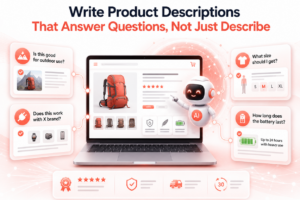
GEO-optimised product content is different. It is written the way a knowledgeable shopkeeper would talk – answering the real questions buyers have before they purchase.
Think about what your customer would type into an AI tool:
- “Is this good for outdoor use?”
- “Does this work with X brand?”
- “What size should I get if I am between sizes?”
- “How long does the battery last with heavy use?”
If your product page answers these questions clearly, an AI tool has something solid to pull from and reference your store. If it does not, the AI moves on to a competitor whose page does.
A simple way to do this is to add a short FAQ section to your top product pages. Even five to eight questions and clear answers can make a real difference in how often AI tools cite your products.
This approach also works directly for your eCommerce SEO – the same content that helps AI tools also helps you rank better on Google.
Step 3: Build Brand Authority That AI Systems Can Verify
AI shopping tools do not just look at your product page in isolation. They cross-check your brand across the web. A store with no reviews, no press mentions, and no third-party presence looks untrustworthy to an AI – even if your products are excellent.
Here is what builds trust in the eyes of AI systems:
Customer reviews on third-party platforms: Reviews on Google, Trustpilot, or niche forums carry far more weight than reviews only on your own website. Actively collect them.
Mentions on other websites: If other sites – blogs, media publications, industry directories – have written about your brand or products, that creates a web of credibility that AI tools recognise.
A strong About Us page: Your story of how you started, how long you’ve been in business, your certifications, and team info all help establish that you are a real, experienced business.
Educational content: Buying guides, how-to articles, and comparison posts position your store as a knowledge source – which is exactly what artificial intelligence systems look for when deciding what to recommend.
Step 4: Speed and Core Web Vitals Are No Longer Optional
A slow store is a problem on multiple fronts. It drives shoppers away, hurts your Google rankings, and now it also reduces your chances of being picked up by AI crawlers.
For Magento stores, the biggest performance gain comes from moving away from the default Luma theme to Hyvä. Luma carries a lot of heavy JavaScript that slows everything down. Hyvä replaces it with a much lighter build, and most stores see dramatic improvements in load times after migration. Our Magento store design team handles this from start to finish.
For Shopify stores, use a fast base theme like Dawn, load images lazily, compress all files, and remove any third-party scripts you are not actively using. Our Shopify design services team can audit and correct performance issues across your entire store.
Figures to aim for:
- LCP (Largest Contentful Paint) below 2.5 seconds
- CLS (Cumulative Layout Shift) below 0.1
- INP (Interaction to Next Paint) under 200ms
Step 5: Optimize Your Google Merchant Center and Product Feed
Google’s AI shopping features are connected to Google Merchant Center. If your product feed contains errors, gaps, or outdated information, those products won’t be eligible to show up in AI-powered shopping results – regardless.
Review your feed and ensure:
- Each product has an accurate GTIN, MPN, or brand identifier
- Prices and stock information are kept up to date
- Product titles include the words shoppers actually search for
- Images are clear, high-quality, and free of text overlays or watermarks
- Shipping and return details are filled in completely
A clean feed without errors gives you the best chance of showing up in Google’s AI shopping recommendations.
Step 6: Build a Conversational Content Layer on Your Store
AI tools are built on natural language. They understand how people actually talk and ask questions. Your store’s blog posts, category pages and product content should do the same.
And that doesn’t mean writing informally or lazily. It means writing the way a helpful, knowledgeable person would explain things – not like a sales brochure.
Practically, this looks like:
- Category page introductions that explain what the category is about and who it suits
- Buying guides for your main product groups (“How to pick the right running shoe for flat feet”)
- Comparison articles (“Foam roller vs massage gun – which one should you buy first?”)
- Use-case pages (“Best home gym equipment for small flats under ₹15,000”)
This type of content is what AI tools pull into their answers when a shopper asks a relevant question. It is also what drives solid long-term eCommerce content marketing results on traditional search.
Step 7: Prepare for Agentic Shopping – Where AI Completes Purchases on Behalf of Users?
This is where things are heading next. Some AI tools are moving beyond recommendations – they are starting to complete purchases on behalf of users. Google has been working on this, and tools like OpenAI’s Operator are already doing it in early form.
To get your store ready for this:
Open up your store via APIs: Magento’s GraphQL API and Shopify’s Storefront API let AI agents browse your catalog, check stock, and start the checkout process without a human clicking through pages. Make sure these are working cleanly.
Keep checkout simple: The more complicated your checkout, the harder it is for an agent to complete a purchase on a customer’s behalf. Guest checkout, clear address fields, and straightforward payment options matter.
Think about headless architecture: AI agents often work best with stores built on a headless or API-first setup. Our team at RiseCommerce has hands-on experience building headless Magento stores for exactly this kind of use case.
Magento vs Shopify: Which Platform Has a Better Head Start for GEO?
Both can be optimised well. They just have different strengths.
Magento gives you much more control. You can configure your schema exactly how you want, build custom API endpoints, set up complex product attribute structures, and handle large catalogs with precise data management. If you are selling automotive parts, B2B products, or anything with many configurable options, Magento’s depth is a real advantage for GEO.
Shopify is faster to get moving. The Google channel integration is built in, the Storefront API works out of the box, and a well-set-up Shopify store can be GEO-ready in less time. For DTC brands and stores with a focused catalog, Shopify is a practical choice.
At RiseCommerce we work across both platforms daily – building custom Magento stores and managing full Shopify migrations. If you are unsure which platform suits your GEO goals better, we can walk you through it.
Common GEO Mistakes That eCommerce Stores Are Making Right Now
Thinking GEO is only about content: Good content helps, but without structured data and a fast site, content alone will not get you cited by AI tools.
Leaving Merchant Center errors unfixed: Feed errors are one of the quickest ways to fall out of AI shopping results. Check your feed regularly.
Short product descriptions: If your product page has three lines of text, an AI has nothing useful to pull from. Your most important products should have detailed, question-answering descriptions.
No review collection process: Stores with few or no reviews do not look credible to AI systems. Build a simple process to ask customers for reviews after every purchase.
Slow mobile experience: A large share of AI shopping queries come from mobile users. If your store loads slowly on a phone, you are losing on multiple fronts.
How RiseCommerce Helps You Implement GEO for Your eCommerce Store?
We have been building Magento and Shopify stores since 2012. Our team has worked on 740+ eCommerce projects – from small DTC stores to large B2B catalogs. We hold Adobe Certification and Hyvä Bronze Partner status, and we understand the technical side of both platforms inside out.
For GEO specifically, we help with:
- Full schema audit and implementation on Magento and Shopify
- Hyvä theme migration for Magento performance
- Google Merchant Center feed cleanup and optimisation
- Product content rewrites built around real buyer questions
- API and headless architecture work for agentic commerce readiness
- Custom module and app development – see our AI Development services
You can also take a look at our eCommerce portfolio to see the kind of work we do.
Conclusion
Shopping behaviour has shifted, and the stores that adapt early will have a clear advantage. AI tools are already directing buyers toward specific products and brands – and the stores showing up in those recommendations are not there by accident. They have done the work to make their data clean, their content useful, and their brand trustworthy.
GEO is not a complicated concept. It is mostly about doing the fundamentals well – structured data, honest reviews, detailed product content, fast pages, and a strong brand presence. These are things every store should be doing anyway. The difference now is that getting them right also determines how visible you are to AI-driven shopping.
Whether you are on Magento or Shopify, start with an honest look at where your store stands on these basics. Fix what is broken, fill in what is missing, and build from there.
If you want a team with real platform experience to help you get this right, we are here.
📞 +91 9839374777
🌐 risecommerce.com
FAQs
1. What is GEO in eCommerce and how is it different from SEO?
SEO helps your store rank higher on Google’s search results page. GEO is about making sure AI tools like ChatGPT, Perplexity, and Google AI Overviews understand your store well enough to recommend your products to shoppers. SEO focuses on keywords and backlinks. GEO focuses on structured product data, brand credibility, and content that clearly answers the questions buyers are asking.
2. Do I need to rebuild my store to get GEO-ready?
No. Most of the work is incremental – adding schema, improving product descriptions, fixing your Merchant Center feed, and improving page speed. You do not need to start over. If your store is on an old, slow theme, an upgrade will definitely help – but it is not a requirement before you can start.
3. Which AI tools should I be optimising for?
Google AI Overviews is the most important one for eCommerce because it connects to Google Merchant Center. After that, Perplexity, ChatGPT with browsing, and Bing Copilot are all worth thinking about. Start with Google – getting your Merchant Center feed right and your schema clean will cover most of the ground.
4. How does product schema markup help with AI recommendations?
Schema markup in JSON-LD format tells AI systems exactly what your product is, what it costs, whether it is available, and what customers think of it. Without it, an AI has to interpret unstructured text – which is unreliable and often leads to your product being skipped. Clean schema makes your data machine-readable and gives you a much better shot at being recommended.
5. Is GEO only for big stores or does it work for small ones too?
It works well for small stores – arguably better. A smaller store with clean data, detailed product pages, and solid reviews can show up in AI recommendations ahead of a large store with messy data and thin content. AI tools do not care about your store’s size. They care about data quality and trustworthiness.
6. How long before I see results from GEO work?
Some things move quickly – fixing Merchant Center feed errors can improve your visibility in Google Shopping AI features within a few days. Building brand credibility takes longer – usually a few months of consistent effort. In general, if you do a solid GEO overhaul, expect to see clear improvement in AI discoverability within 60 to 90 days.
7. Why does the Hyvä theme matter so much for Magento and GEO?
Hyvä replaces Magento’s heavy Luma frontend with a much lighter build. This directly improves Core Web Vitals – particularly LCP, which AI crawlers pay attention to. Most stores that move from Luma to Hyvä see load time improvements of 60 to 80 percent. The cleaner HTML also makes it easier for crawlers to read and understand your product content.
8. Should I do GEO or SEO – or both?
Both. They share the same foundations – fast pages, structured data, quality content, and a credible brand. Doing good SEO work also helps your GEO, and vice versa. There is no reason to choose between them. If your budget is limited, start with the technical basics – schema, feed, and page speed – since those improve both at the same time.
9. How do I know if AI tools are already recommending my store?
The simplest way is to test it yourself. Open ChatGPT, Perplexity, or Google’s AI Overviews and ask questions about products in your niche. See if your store comes up. Also keep an eye on your Google Merchant Center data for any AI shopping surface impressions. For a more thorough picture, set up Google Alerts for your brand name and run a proper GEO audit.
10. How do I get started?
Begin with an audit. Check your schema, your Merchant Center feed, your page speed on mobile, and your top product pages. Pick your ten best-selling products and make sure each one is fully optimised before moving on to the rest of the catalog. If you want experienced hands to do this with you, call us on +91 9839374777 or visit RiseCommerce to contact us – we will take a look at your store and tell you exactly where to focus first.